The Knock
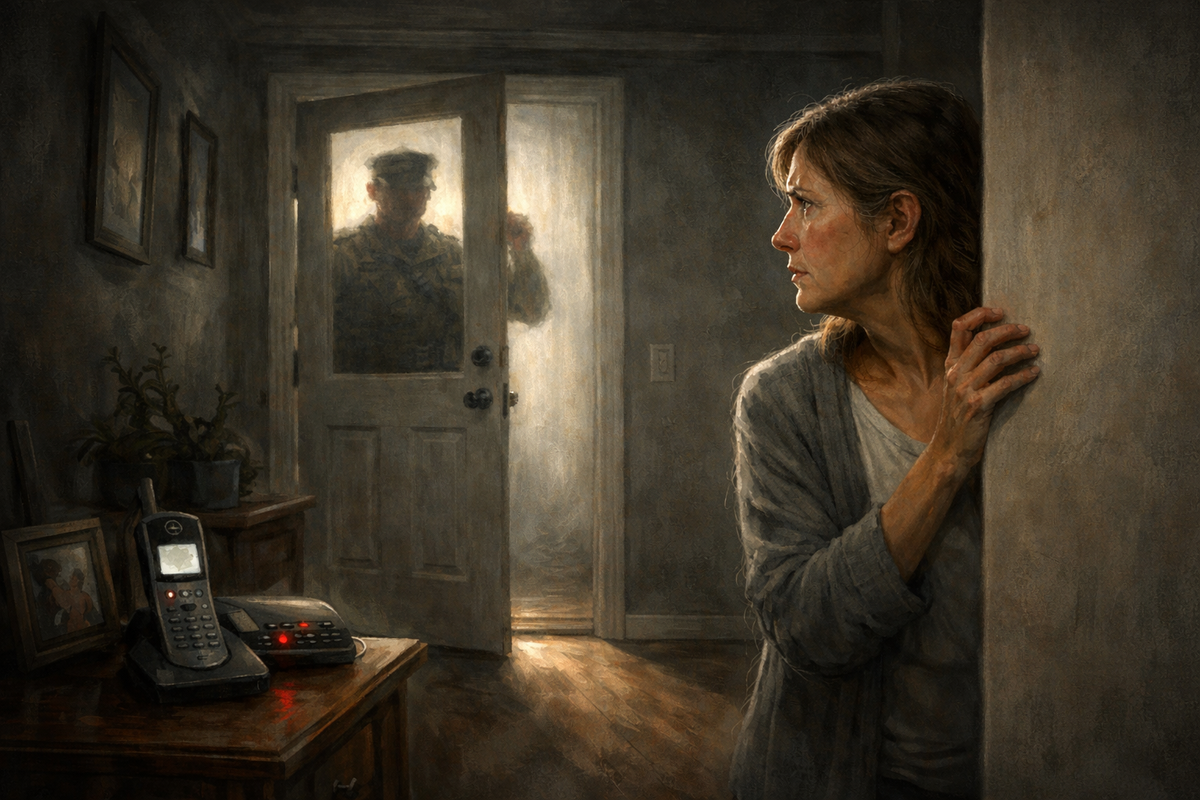
The phone began ringing at 9:12 in the morning.
Elaine watched it vibrate across the kitchen bench like a trapped insect. She didn’t move. The sound echoed through the house—shrill, insistent, unbearable. After the fourth ring it stopped.
Silence returned.
She kept staring anyway.
The house had become very quiet since Daniel left for the Marines. Quiet in the way hospitals are quiet—careful, fragile, like everyone is holding their breath.
The phone rang again.
Elaine pressed her lips together and folded the dish towel in her hands for the third time. Daniel used to tease her about that.
Mom, the towel’s already folded.
She let it ring until it stopped.
Bad news traveled by phone sometimes, she knew that. But mostly it came another way. There were rules for these things. Procedures. The Marines didn’t send emails or texts when a boy died in a desert thousands of miles away.
They came in person.
Two uniforms.
A knock.
She had read about it somewhere. Mothers always said the same thing afterward: I knew the moment I opened the door.
So Elaine stopped opening the door.
Three weeks ago the first knock had come. Sharp. Official. She had been watering the plants and the sound had turned her blood cold.
She froze in the hallway.
Another knock.
“Ma’am?”
A man’s voice.
Her heart hammered so violently she thought she might faint. She stood there, staring at the door, imagining what waited on the other side. Two Marines in dress blues. Hats tucked under their arms. Faces stiff with rehearsed sympathy.
We regret to inform you…
She backed away slowly, step by step, until the hallway swallowed her.
The men knocked for several minutes. Then their footsteps retreated down the path.
The next day the phone started ringing more often.
Now she didn’t answer that either.
Elaine had developed a system. If the phone rang she would sit perfectly still until it stopped. If someone knocked she would hold her breath until they went away.
It was working.
As long as she didn’t answer, Daniel could still be alive.
Outside, a car passed. Somewhere a dog barked. The world carried on in its careless way.
Elaine poured herself a cup of tea and sat at the kitchen table.
She thought about the last morning she saw him.
Daniel had stood in the doorway wearing a uniform that still looked too new, too stiff. Twenty years old and trying very hard to look like a man.
“You don’t have to wait up for me to call,” he had said, smiling.
“I will anyway.”
“You always do.”
He hugged her before leaving, squeezing so tight she could barely breathe.
“Mom,” he said into her hair, half laughing, half serious, “I’m going to be okay.”
She remembered watching him walk down the driveway. The sun had been bright that morning. Birds loud in the trees.
The phone rang again.
Elaine didn’t look at it.
Instead she stared at the front door across the hall. It seemed heavier now than it used to be, like it held the weight of the entire world on its hinges.
Another ring.
Another.
The answering machine clicked on.
“Hi Mom.”
Elaine’s head snapped up.
Her heart lurched.
“I know you’re probably not picking up because it’s early there, but it’s me.”
She stood slowly.
Daniel’s voice filled the quiet house—familiar, alive, impatient.
“I finally got a chance to call. Everything’s fine. I’m safe.”
Elaine stared at the phone as if it were a ghost.
“I tried yesterday too,” he continued. “And the day before. You never answer.”
Her hand trembled as she reached toward the receiver.
“I guess you’re out or something,” he said with a small laugh. “Anyway… just wanted you to know I’m okay.”
The machine beeped.
Silence.
Elaine stood frozen.
Then suddenly the doorbell rang.
A single sharp chime.
Her blood turned to ice.
She looked toward the front door, fear surging through her chest so violently she could hardly breathe.
Another knock followed.
Firm.
Official.
Her legs felt weak.
This is it, she thought.
This is how it happens.
For a long moment she stood in the kitchen, caught between the phone and the door.
The phone where her son’s voice had just been.
The door where the truth might be waiting.
The knock came again.
Elaine wiped her hands on the towel and walked slowly down the hallway.
Each step felt like walking toward a cliff.
When she reached the door she hesitated.
On the other side someone shifted their weight. She could hear boots on the porch.
Her fingers closed around the handle.
She opened the door.
A young Marine stood there in dusty fatigues, holding a clipboard.
Elaine’s heart stopped.
Then the Marine smiled awkwardly.
“Ma’am, sorry to bother you,” he said. “We’ve been trying to reach you.”
Her voice barely worked.
“Yes?”
He glanced down at the paper.
“We had trouble contacting you about a call from your son. Communications were down for a bit, but he’s safe and asked us to make sure you got the message.”
Elaine felt the world tilt.
The Marine shifted again, scratching his neck.
“He said you weren’t answering your phone.”
The tension drained out of her so suddenly she had to grab the doorframe.
A laugh escaped her—half sob, half relief.
Behind her, the phone began ringing again.
She turned and ran for it.
On the 28th February 2026 the Trump Administration ordered US airstrikes on targets in Iran, escalating tensions into a broader military conflict in the region. Trump addressed the public on his social media platform commenting bluntly, cavalierly "There will be lives lost." Only 1 in 4 Americans support the US strikes on Iran. There is doubt regarding the actual risk to security to the American people posed by the Iranian regime, the necessity to cause this escalation, and not much confidence in the Trump Administration's plans in terms of likely outcomes and deescalation. But this is the human cost.
